The era of AI is evolving more rapidly than anything we’ve ever seen before. There was a time when we couldn’t have imagined a level of efficiency in BUSINESS or MARKETING without getting our hands dirty. But as we all know, those processes were exhausting, and we genuinely needed something that would work like magical elves of the night. AI arrived as mysteriously as those elves ready to sway their magic wand or just simply do half of the work for us.
Whether we were ready to accept it or not was entirely no longer dependent on us, for it took us along for the ride. Particularly in the vast world of marketing that shifted to digital, we've witnessed changes so significant that many of us, including experts, find it hard to keep up. With the launch of AI, these changes have only accelerated beyond our pace. That’s how powerful it is.
Emerging technologies are now challenging traditional SEO methods that have been effective for years. AI tools such as ChatGPT, Gemini, Perplexity, and Google's AI Overviews are transforming how people search and get the information. This change presents new opportunities and challenges for businesses, especially those working with an SEO company in Delhi NCR or seeking to enhance their online visibility.
If you're running a business in India or working with a digital marketing agency in Delhi, understanding these changes is crucial for staying ahead of the competition.
AIO is a broader term that means making your content and online presence work better with AI systems. It's about ensuring that AI tools can find, understand, and recommend your content when people ask questions. Think of it as preparing your website and content for the AI-powered future.
AEO is about making your content easily discoverable and citable by AI assistants when they respond to users. It's similar to earning featured snippets on Google, ensuring that when someone asks ChatGPT or Perplexity a question, your content is the source they reference.
Traditional SEO has always been about ranking higher on Google search results. Competing in the race of getting ranked on the 1st page, finally winning and landing in the top 10 sites list, and celebrating that win; however, AEO is a different race altogether, but it has some common quality factors that are to be given more highlight than ever before because it focuses on:
Getting cited by AI tools instead of just ranking on Google
Creating content that AI can easily understand and summarise
Building authority and trust that AI systems recognise.
Being mentioned in high-quality sources that AI platforms trust
Many SEO services in Delhi NCR are now adapting their strategies to include these new optimisation techniques.
People are increasingly getting answers directly from AI tools without clicking on websites. This implies a potential decrease in traditional website traffic, as AI's citations have become increasingly valuable. If you're working with the best digital marketing agency in Delhi NCR, then they should already be preparing for this shift.
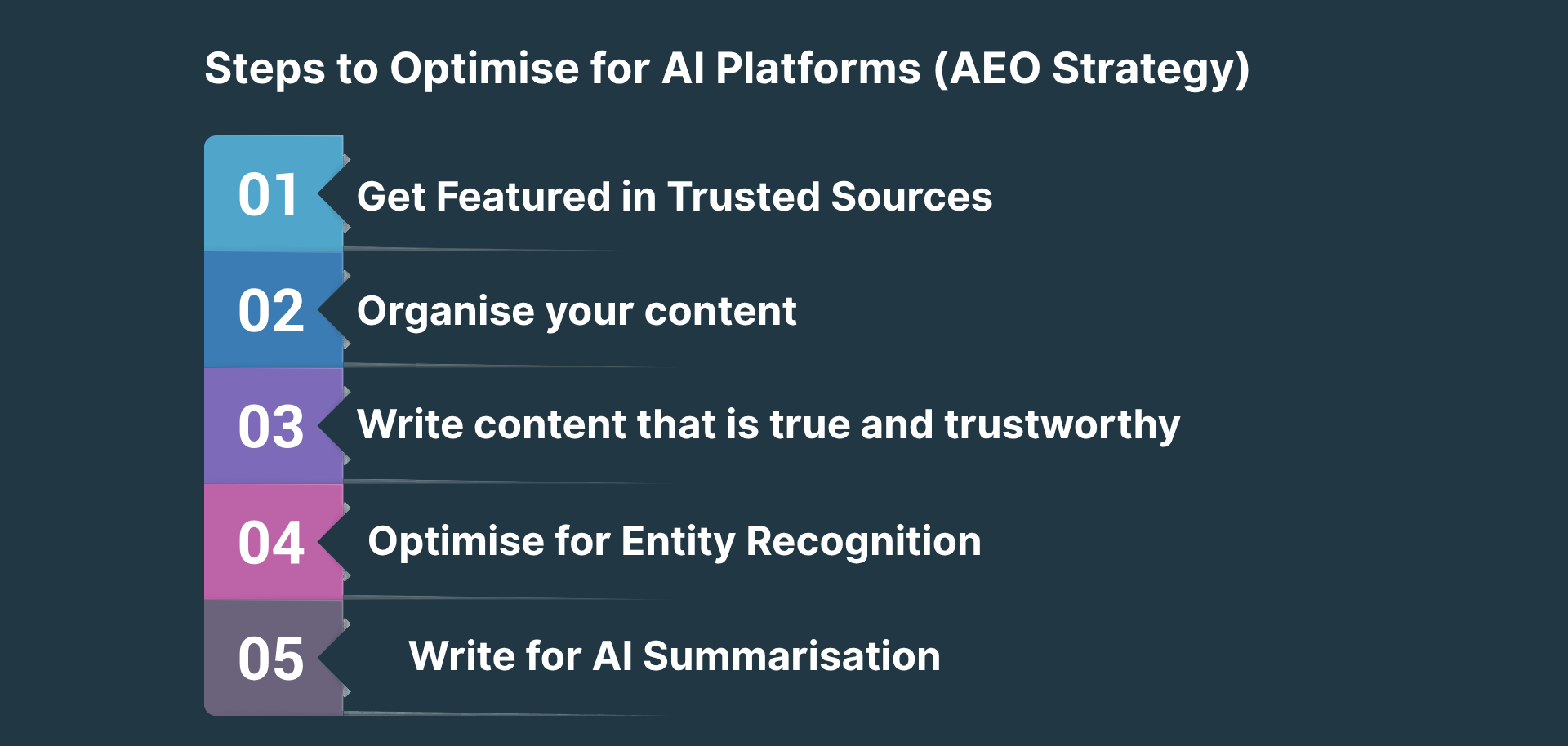
AI platforms trust websites that people already think are safe. Getting mentioned in news articles should be your main goal.
Adding to Wikipedia or government websites
Being mentioned on educational (.edu) sites
Making connections with well-known business magazines
It's clear that AI likes stuff that is easy to read and understand:
Use headings and subheadings that are easy to read.
Include FAQ sections in your blog content.
Make how-to guides and step-by-step instructions. Use bullet points and lists.
Use schema markup to make it easier for AI to understand your material.
AI systems put a high value on accuracy and dependability:
Look at studies and sources that are reliable.
Don't make assertions that are too big.
Include the author's qualifications and area of expertise.
Fact-check all information before publishing
Update content regularly to keep it current
Help AI systems understand what your business is about:
Set up and optimise your Google Business Profile
Ensure your business information is consistent across all platforms
Create profiles on relevant industry directories
Use structured data to provide context about your business
Since AI often summarises content from multiple sources:
Use simple, clear language.
Keep paragraphs short and focused.
Include one strong, quotable sentence in each section
Make your key points easy to extract and cite.
More people are getting answers directly from AI tools without visiting websites. This trend is already visible and will likely continue growing.
Users increasingly read summarised answers instead of clicking through to websites. This means getting cited becomes more important than just ranking high.
SEO agencies in Delhi NCR now need to focus more on technical aspects like structured data, entity optimisation, and building citations from authoritative sources.
Businesses with expert-driven content
Websites with thin, generic content
Q1: Do I still need traditional SEO if AEO is the future?
A1: Yes, traditional SEO is still important. AEO builds on top of good SEO practices. The best approach is to combine both strategies for maximum visibility.
Q2: How long does it take to see results from AEO efforts?
A2: AEO results can take 3-6 months or longer to show, similar to traditional SEO. Building authority and getting cited by AI systems takes time and consistent effort.
Q3: Should I stop focusing on Google and only optimise for AI?
A3: No, Google is still the dominant search engine and is integrating AI into its results. A balanced approach works best—optimise for both traditional search and AI platforms.
Adapting to AI and answer engines is the key to the future of SEO. AIO and AEO are the next steps in the logical progression of search engine optimisation. As AI becomes more important in how consumers find information, businesses that start getting ready now will have a big edge.
The move to AI-powered search isn't simply a fad; it's the way things are going. To stay ahead of your competitors tomorrow, start optimising for it today.
Submit your details and someone from our team will contact you shortly.